1 Step by Step: The Consumer’s Optimal Choice
1.1 Setup
A consumer chooses a bundle \((x, y)\) of two goods. Preferences are represented by a utility function:
\[u(x, y)\]
The price of good \(x\) is \(p_x\) and the price of good \(y\) is \(p_y\):
\[p_x = 4 \qquad\qquad p_y = 1\]
The consumer’s income is \(I\):
\[I = 36\]
The budget constraint is:
\[p_x\,x + p_y\,y = I \;\;\Longrightarrow\;\; 4x + y = 36\]
The consumer chooses the bundle that maximizes utility subject to the budget constraint.
Three preferences:
\[u = x^{1/3}y^{2/3} \qquad\quad u = \tfrac13 x + \tfrac23 y \qquad\quad u = \min\left\{\tfrac13 x,\ \tfrac23 y\right\}\]
1.2 Cobb-Douglas: \(u = x^{1/3}y^{2/3}\)
1.2.1 Tangency condition
Marginal utilities:
\[MU_x = \tfrac13 x^{-2/3}y^{2/3} \qquad\qquad MU_y = \tfrac23 x^{1/3}y^{-1/3}\]
Dividing:
\[MRS = \frac{MU_x}{MU_y} = \frac{y}{2x}\]
Setting equal to \(p_x/p_y\):
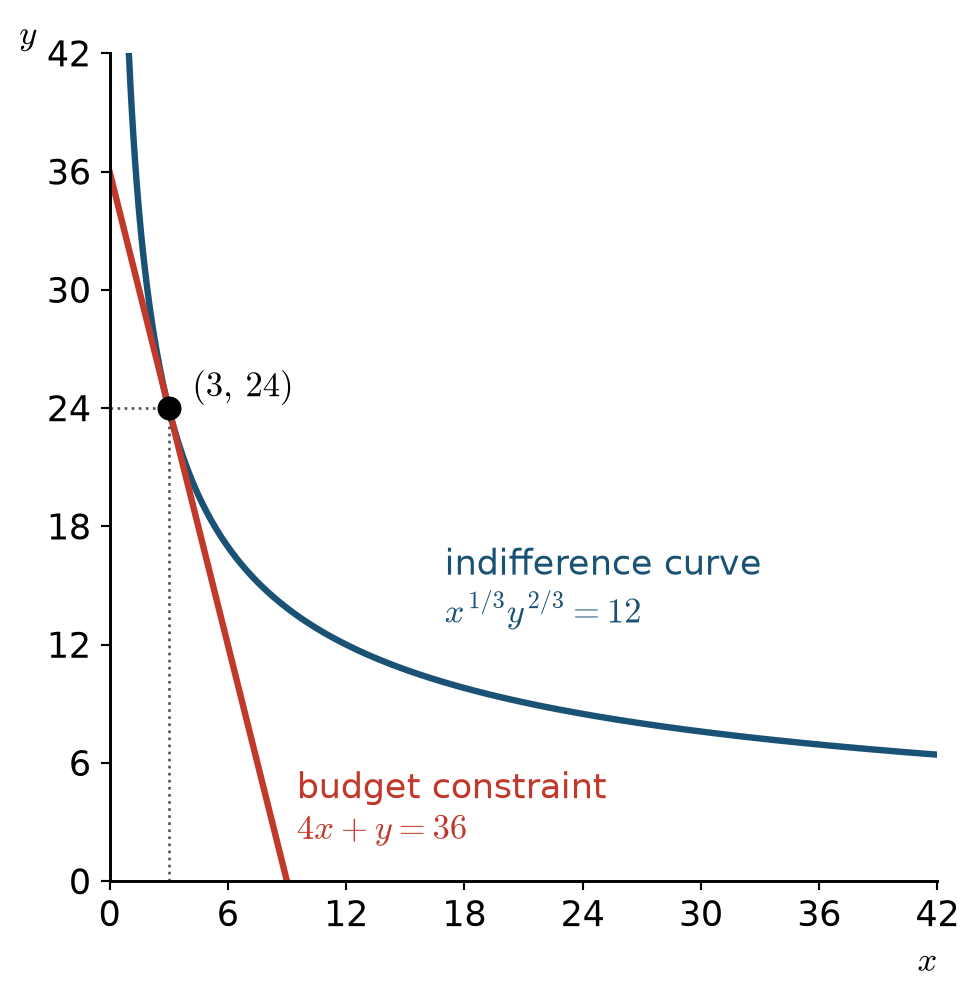
\[\frac{y}{2x} = \frac{4}{1} \;\;\Longrightarrow\;\; y = 8x\]
1.2.2 Optimal choice
Substituting \(y = 8x\) into the budget constraint:
\[4x + 8x = 36\]
Solving:
\[x = 3 \qquad\qquad y = 8\cdot 3 = 24\]
1.2.3 Utility attained
Evaluating at \((3, 24)\):
\[u(3, 24) = 3^{1/3}\cdot 24^{2/3} = 3^{1/3}\cdot 4\cdot 3^{2/3} = 12\]
1.2.4 Indifference curve and budget constraint
1.3 Perfect substitutes: \(u = \tfrac13 x + \tfrac23 y\)
1.3.1 Comparing \(MRS\) and \(p_x/p_y\)
Marginal utilities:
\[MU_x = \tfrac13 \qquad\qquad MU_y = \tfrac23\]
Dividing:
\[MRS = \frac{1/3}{2/3} = \frac12 \qquad\qquad \frac{p_x}{p_y} = 4\]
Comparing:
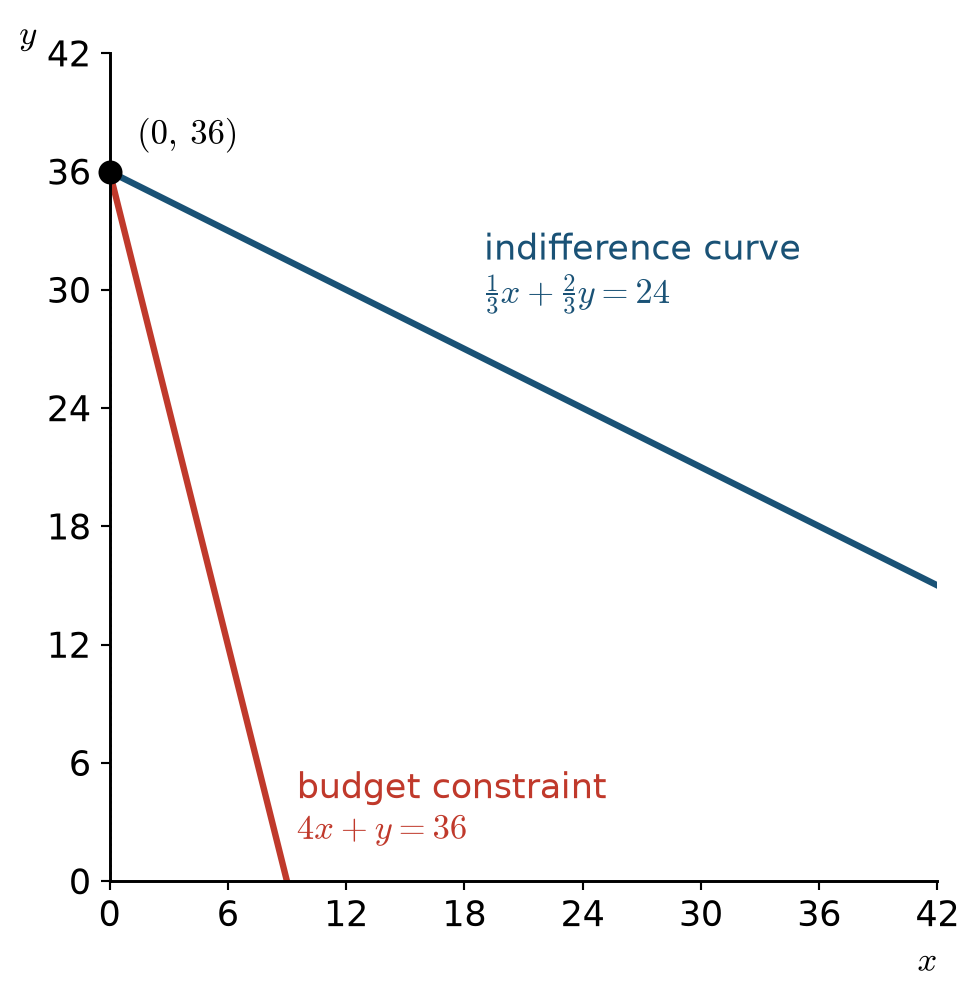
\[MRS < \frac{p_x}{p_y} \;\;\Longrightarrow\;\; x = 0\]
1.3.2 Optimal choice
Substituting \(x = 0\) into the budget constraint:
\[4\cdot 0 + y = 36\]
Solving:
\[x = 0 \qquad\qquad y = 36\]
1.3.3 Utility attained
Evaluating at \((0, 36)\):
\[u(0, 36) = \tfrac13\cdot 0 + \tfrac23\cdot 36 = 24\]
1.3.4 Indifference curve and budget constraint
1.4 Perfect complements: \(u = \min\left\{\tfrac13 x,\ \tfrac23 y\right\}\)
1.4.1 Fixed-proportions condition
Without wasting either good:
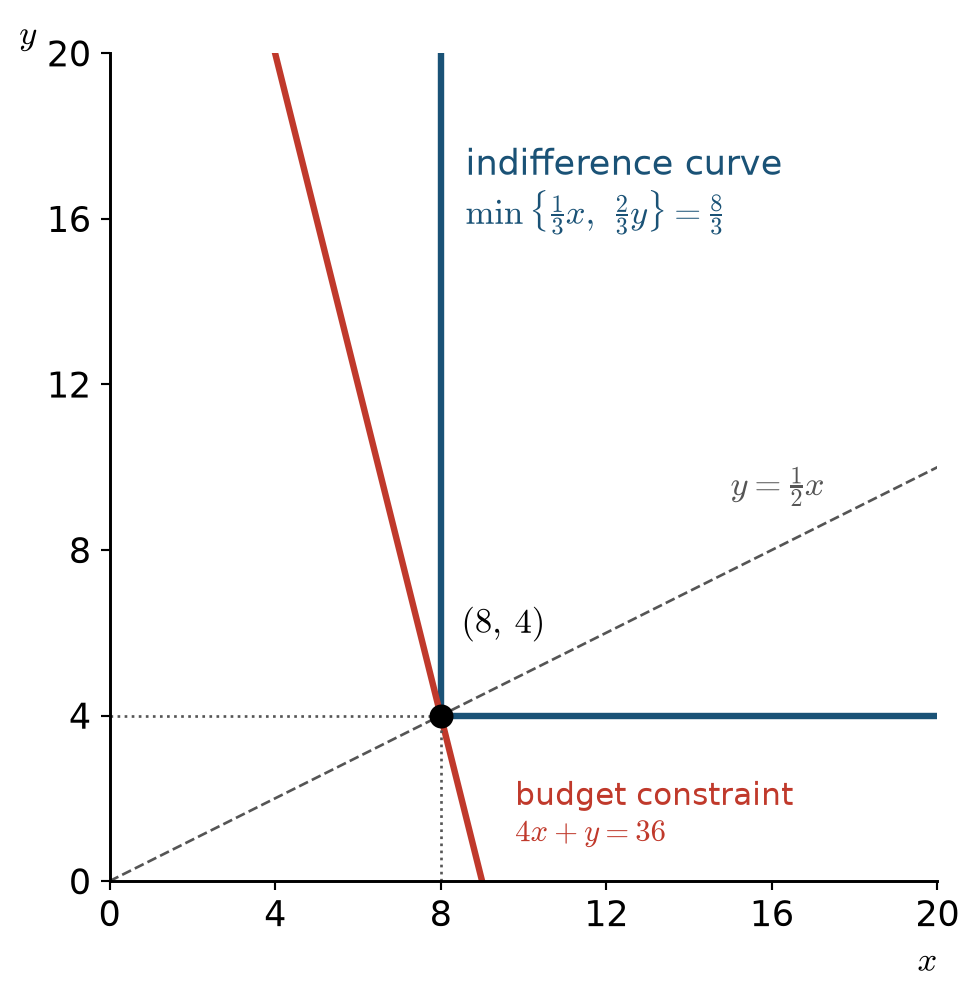
\[\tfrac13 x = \tfrac23 y \;\;\Longrightarrow\;\; x = 2y\]
1.4.2 Optimal choice
Substituting \(x = 2y\) into the budget constraint:
\[4\cdot 2y + y = 36 \;\;\Longrightarrow\;\; 9y = 36\]
Solving:
\[y = 4 \qquad\qquad x = 2\cdot 4 = 8\]
1.4.3 Utility attained
Evaluating at \((8, 4)\):
\[u(8, 4) = \min\left\{\tfrac13\cdot 8,\ \tfrac23\cdot 4\right\} = \min\left\{\tfrac83,\ \tfrac83\right\} = \tfrac83\]
1.4.4 Indifference curve and budget constraint